Earth Vital Signs
Updated: September 2026The Pulse of a Fragile Sphere
These four indicators provide different views of a changing planet. Atmospheric carbon dioxide affects Earth's energy balance, global temperature helps reveal long-term warming trends, sea-level measurements show changes occurring across the world's oceans, and Arctic sea-ice observations reveal changes in one of Earth's most sensitive regions.
No single measurement tells the whole story. Together, these datasets help us observe changes in Earth's atmosphere, oceans, ice, and climate system over time. The purpose of this dashboard is not to turn complex science into a single number, but to make some of the planet's most important measurements easier to explore.

Live Earth — NASA Worldview
NASA Worldview allows you to explore satellite observations of Earth and examine how natural events and environmental conditions appear from space. Browse imagery, compare observations, and explore different datasets across the planet.
The Pale Blue Dot: A View from the Void
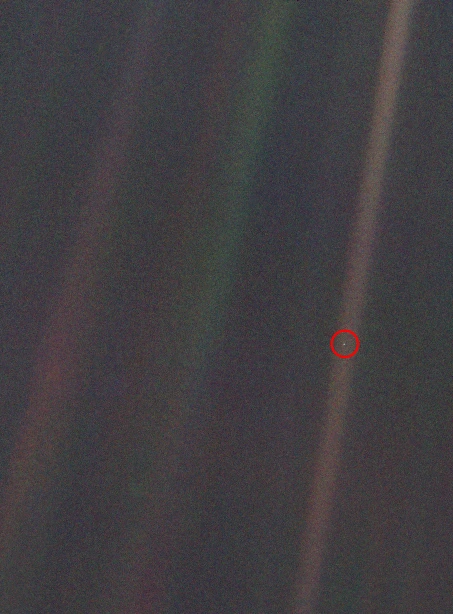
On September 5, 1977, NASA launched the Voyager 1 spacecraft on a grand mission to explore the outer giants of our solar system, primarily Jupiter and Saturn. After completing its planetary encounters and rewriting our understanding of the cosmos, the probe began its long, solitary drift toward interstellar space. On February 14, 1990, at the urging of astronomer Carl Sagan, NASA engineers commanded the spacecraft to turn its cameras around one last time. From a staggering distance of 6 billion kilometers—just before its cameras were permanently powered off to conserve energy—Voyager 1 captured the "Pale Blue Dot."
In that grainy, iconic photograph, Earth is less than a single pixel. When we build mechanical eyes and launch them into the freezing vacuum of space, this is the ultimate truth they reveal. We do not see nations, borders, or endless horizons; we see a fragile, isolated sphere suspended in a sunbeam against the infinite dark.
As Sagan famously observed, every human triumph, every unspoken word, every brilliant scientific discovery, and every unfinished journey takes place on this solitary speck. Monitoring Earth's vital signs today is not merely an exercise in data collection. It is a profound act of cosmic self-awareness—our attempt to understand, measure, and protect the only home we have ever known in a vast and silent universe.
Monitoring the Planetary Engine
The tools below let you explore Earth through different kinds of observations and datasets. Some show near-real-time events, while others reveal changes that unfold over years or decades. Together, they provide different ways to observe Earth's atmosphere, oceans, land, ice, and changing environment.
ABOUT THE DATA
The information presented on this page is collected from scientific and Earth-observation resources provided by organizations including NASA, NOAA, NSIDC, ESA, and other official data providers. Values shown in the dashboard may change as source datasets are updated.
Whiteheart9 organizes and presents these resources as an independent educational experience. Whiteheart9 is not affiliated with NASA, NOAA, ESA, or the other organizations referenced on this page.